
Trading Compute: GPU Power Becomes a Commodity
By: Buster Wurm & Joe Miscioscia
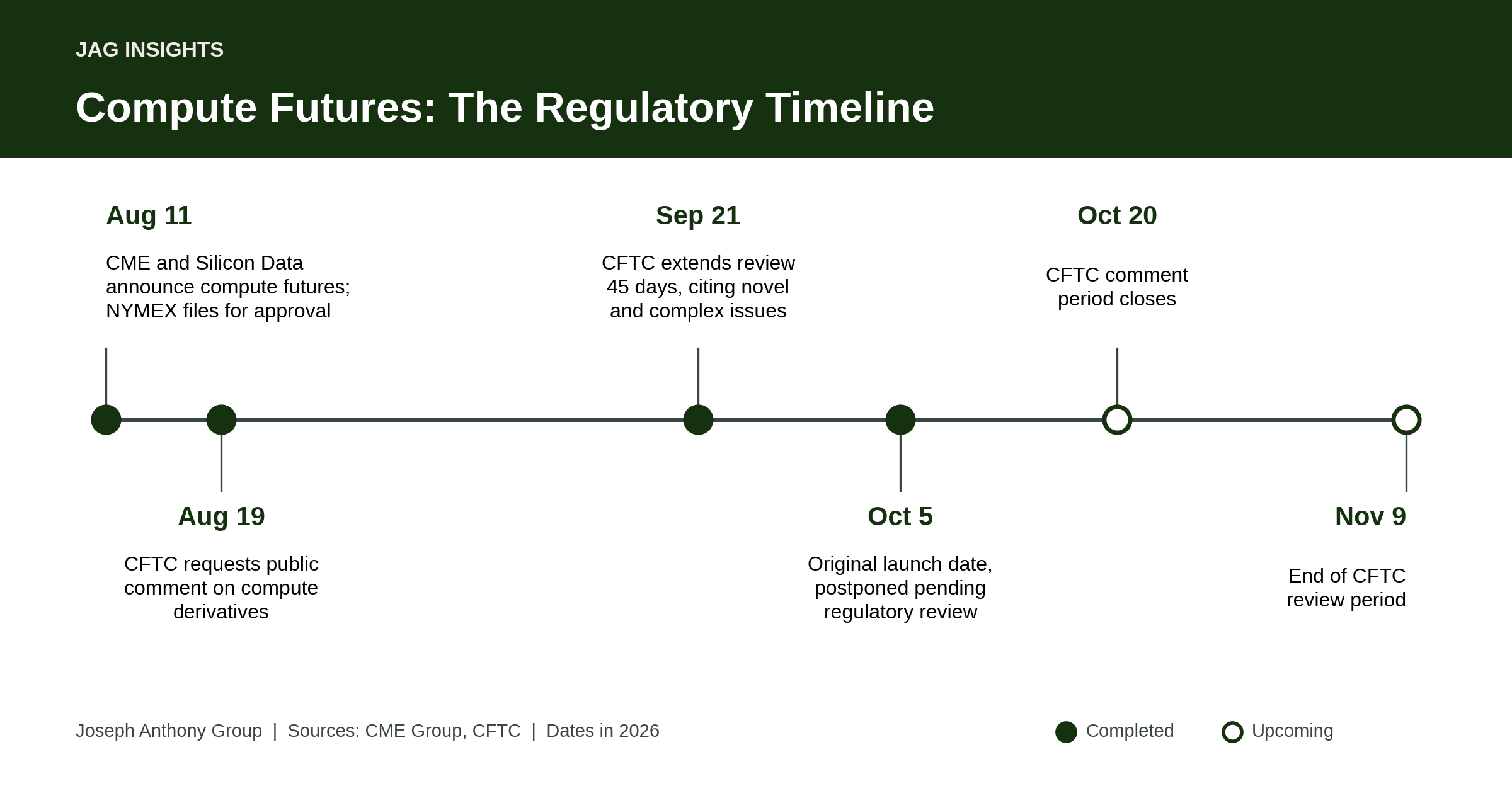
GPU compute, the processing power behind AI, is on its way to becoming a commodity in financial markets. CME Group and Silicon Data had planned to list the first U.S.-regulated compute futures on NYMEX on October 5, 2026. That launch was postponed after the CFTC extended its review of the contracts by 45 days, through November 9, citing novel and complex issues. November 9 is a review deadline, not a launch date; CME now says the contracts will launch later this year, pending regulatory review. The underlying challenge is turning a fragmented service into an asset companies can reliably trade and hedge.
“The most interesting second-order effect I see over the next two to three years isn’t the models themselves, it’s the selling and trading of compute power.”
How Compute Futures Work
A futures contract sets a price today for buying or selling an underlying exposure at a future date. CME’s proposed contracts reference rental time on NVIDIA’s H100 and B200 chips, quoted in dollars per GPU-hour. Each contract represents 730 GPU-hours, roughly one chip’s monthly capacity, with monthly contracts listed out 36 months. Settlement is in cash against the average of Silicon Data’s business-day rental benchmarks during the contract month. These indices standardize observations across providers for hardware specifications, rental terms, performance, and geography, and filter outliers. Both contracts reference the non-hyperscaler, or neocloud, segment of the market. The index is the published reference price that determines settlement; holding a contract does not reserve any computing capacity.
Why Now
The commercial rationale is growing exposure to large, volatile compute bills. AI training and inference require substantial capacity, while new chip generations, supply constraints, and shifting workloads continually reshape rental prices. Opaque bilateral agreements make prices difficult to compare. Futures could give companies a common price reference and greater budget certainty.
The Venues Taking Shape
Venue design matters. ICE and Ornn plan dollar-denominated, cash-settled futures tied to the Ornn Compute Price Index, which is built from executed transactions; those contracts are also subject to regulatory approval. Architect’s Bermuda-regulated AX exchange already offers H100 perpetual futures referencing Ornn data: contracts without expiry that use funding payments to keep prices aligned with spot, and that accept USD or USDC collateral. Kalshi lists binary GPU-price contracts that resolve on whether an H100 benchmark price exceeds specified thresholds. These provide event-based exposure rather than the continuous price exposure of conventional futures.
Who Trades Compute
Hedgers and speculators play complementary roles. AI labs and cloud buyers can buy futures to offset rising rental costs. Data center operators and cloud providers selling capacity can sell futures to protect against falling rental revenue. Quantitative, proprietary, and macro trading desks can take positions without consuming compute, accepting price risk and contributing liquidity. Commercial participation anchors the market in real demand; speculative participation helps counterparties find one another.
A Commodity Unlike Any Other
Compute nevertheless resists the usual commodity model. An unused GPU-hour simply expires; it cannot be warehoused, transported, or carried into tomorrow. For storable commodities, cost-of-carry pricing connects spot and futures through financing, storage costs, and the benefits of holding inventory. That arbitrage link is absent here. Rapid hardware depreciation and differences among chips further complicate valuation. A benchmark may also diverge from a company’s actual bill, creating basis risk and making liquid, reliable hedges harder to establish.
The Regulatory Test
The CFTC, which oversees U.S. futures markets, is examining the category as a whole. In August it issued a request for comment on compute derivatives covering cash-market size and liquidity, manipulation risk, customer protection, and perpetual compute futures, with the comment period closing October 20, 2026. No rule has been adopted, and CME’s contracts remain under review. That scrutiny underscores the central test: whether credible benchmarks and sustained participation can support useful risk transfer. Compute is becoming tradable, but a mature commodity market still has to be built.
What This Means for Firms and Talent
For trading firms, compute futures apply a familiar playbook to an unfamiliar underlying. The desks best positioned to make markets and take risk here will need people who understand both sides: traders and quantitative researchers fluent in commodity and power-market structure, where non-storable underliers and basis risk are already routine, paired with data and infrastructure specialists who understand how GPU capacity is actually priced, provisioned, and consumed. That combination is rare today.
As the regulatory picture clarifies, we expect early demand for power and energy traders retooling for compute, index and benchmark specialists, and risk professionals who can model the basis between a published index and a real compute bill. The firms that build that bench ahead of approval will be the ones ready to provide liquidity on day one.
Sources:
Extension of Review Period: NYMEX Submissions 26-370 and 26-370S (CFTC)
CFTC Requests Comment on the Listing of Compute Derivatives Contracts (CFTC)
NYMEX Submission 26-370: Voluntary Submission for Product Approval (CFTC)
CME Group and Silicon Data to Launch Compute Futures (CME Group)
H100 Rental Price Index: Benchmark and Methodology (Silicon Data)
GPU Futures: How Compute Is Becoming a Tradable Commodity (Silicon Data)