
Perpetual Futures Come Onshore: Crypto Derivatives Under CFTC Oversight
By: Buster Wurm & Joe Miscioscia

In our last article, we looked at how Hyperliquid showed what perpetual futures look like outside traditional market structure: continuous access, stablecoin collateral, wallet-based onboarding, and protocol liquidation. The next phase is not the disappearance of that model. It is the migration of the product into the United States regulatory perimeter. On May 29, 2026, the CFTC approved Kalshi's BTCPERP contract as a futures contract, creating a path for domestic exchange-listed perpetuals.
A Narrow Framework
The framework is narrow. The CFTC limited its analysis to bitcoin and similar contracts on digital commodities with deep and continuous spot trading. That matters because a perpetual has no expiration date. Its funding mechanism must rely on observable spot prices, liquidity, and real-time arbitrage to keep the contract aligned with the underlying asset. Products outside that category remain subject to case-by-case review.
Three Implementation Models
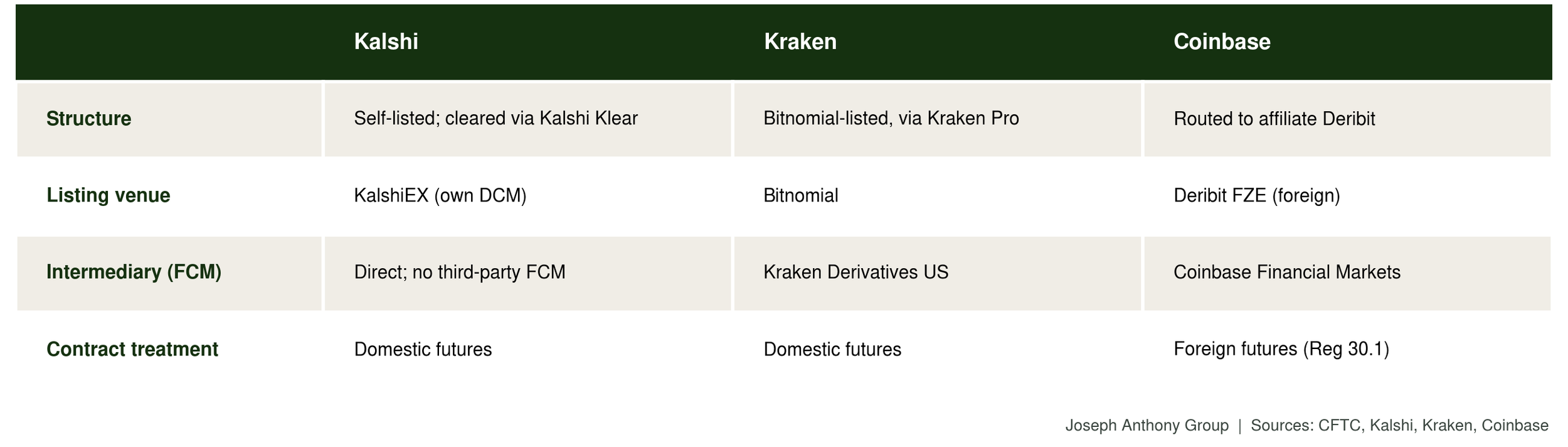
The three implementation models show the structure's flexibility. Kalshi lists and clears perpetuals within its regulated exchange framework. Kraken distributes contracts listed on Bitnomial through Kraken Pro, with Kraken Derivatives US serving as the registered futures commission merchant. Coinbase takes a different route through its affiliate relationship with Deribit. Registered FCMs connect eligible clients to contracts the CFTC permits to be treated as foreign futures, while customer collateral moves through a conditional foreign broker arrangement. Coinbase's route is launching with options for institutions first, with perpetual futures and retail access to follow.
Why FCM Intermediation Matters
FCM intermediation is the institutional bridge. An FCM accepts orders and margin, maintains records, and connects customers to exchanges and clearing infrastructure. CFTC rules require customer funds for domestic futures to be segregated from the firm's own assets, while foreign futures accounts are subject to a secured amount framework. This structure does not eliminate risk, but it creates governance, custody, disclosure, and capital controls.
Onshore vs. Offshore
That is the practical distinction from offshore trading. Hyperliquid emphasizes direct wallet access, crypto collateral, rapid listings, and fewer intermediaries. Regulated United States venues add Know Your Customer (KYC) checks, centralized clearing, formal margin models, leverage controls, surveillance, and identifiable legal counterparties. These requirements may reduce flexibility, but they can make participation more workable for institutions, registered investment advisers, and domestic funds whose mandates restrict offshore exposure.
The Hiring Impact
The hiring impact follows. Firms will need derivatives traders, quantitative researchers, margin and liquidation specialists, clearing operations professionals, and legal and compliance talent fluent in CFTC and FCM rules. Onshoring shifts demand toward professionals who can combine crypto market knowledge with experience in regulated derivatives. The bridge between offshore innovation and domestic supervision is becoming an operating model, not just a regulatory concept.
Sources:
Order Approving the KalshiEX BTCPERP Futures Contract (CFTC)
Commission Staff Confirms Certain Crypto Asset Perpetuals as Foreign Futures (CFTC)
CFTC Guidance on Futures Commission Merchants and Customer Funds (CFTC)
Announcing CFTC-Regulated Perpetual Futures for US Traders (Kraken)
Kraken Taps Bitnomial Deal to Unlock CFTC-Regulated Perpetual Futures (TradingView)
Kalshi Launches First-Ever Perpetual Futures in America (Kalshi)
Coinbase Brings Global Crypto Derivatives to the US Market (Coinbase)
Perpetual Futures Come Onshore: The CFTC's New Regulatory Framework (Katten)
The Crypto Market Structure Shift: Trading Oil on Hyperliquid (Joseph Anthony Group)