
Prediction Markets Go Institutional: A New Trading Venue Takes Shape
By: Buster Wurm & Joe Miscioscia

Prediction markets have spent much of the past decade as an election-night sideshow. At their core, they allow traders to buy and sell contracts tied to the outcome of defined events, turning expectations about real-world outcomes into tradable prices. This spring, they began to look less like a novelty and more like an emerging asset class.
The scale of capital tells the story. Combined volume across the sector reached roughly $29.8 billion in April 2026. Kalshi closed a $1 billion Series F at a $22 billion valuation led by Coatue, with Sequoia, a16z, Paradigm, and Morgan Stanley participating. ICE, the parent of the NYSE, committed up to $2 billion to Polymarket at an approximately $8 billion pre-investment valuation. And on June 10, the CFTC proposed a rule setting out a public-interest test for which event contracts CFTC-registered exchanges may list, rather than a blanket clarification of scope.
Two Models
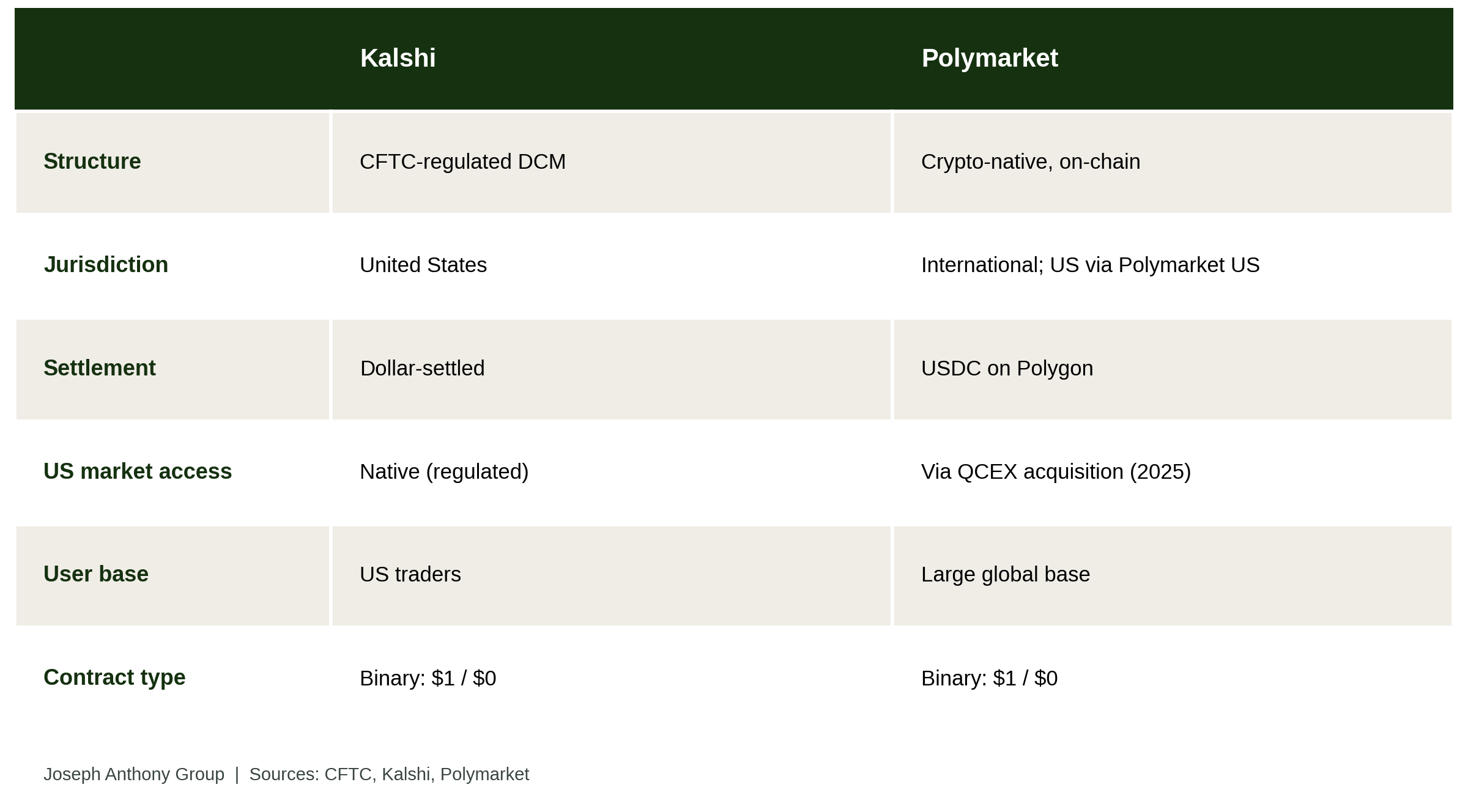
Two models dominate. Kalshi operates as a CFTC-regulated designated contract market, using dollar-settled contracts within the U.S. derivatives framework. Polymarket is crypto-native and trades on-chain internationally, settling in USDC on Polygon and serving a large global user base. In both, a typical binary contract settles at $1 if the specified event occurs and $0 if it does not, so its trading price can be read as the market's implied probability of that outcome, with settlement based on a predefined source or verifiable result. Polymarket's U.S. return followed its 2025 acquisition of QCEX, which included a CFTC-licensed exchange and clearing infrastructure and was later renamed Polymarket US.
The Institutional Influx
Retail flow, concentrated in sports and politics, still drives much of the headline volume. Institutional participation, however, is the newer story. Kalshi has reported an 800% increase in institutional trading volume over six months as market makers, quantitative and proprietary trading desks, and firms using event contracts to hedge macroeconomic and event-specific risks have entered the market.
Regulation Takes Center Stage
Regulation remains the central open variable. The CFTC's June proposal would amend Rule 40.11 and establish a framework for determining whether contracts involving gaming, war, terrorism, assassination, or unlawful activity are contrary to the public interest, and therefore barred from listing on CFTC-registered exchanges. Sports contracts remain particularly contested, as federal derivatives oversight intersects with state gaming regulation, and insider-trading and market-integrity safeguards are receiving greater scrutiny as volumes scale.
Liquidity and Market Making
Liquidity still trails notional turnover by a wide margin, with sector-wide open interest of roughly $1.1 billion as of mid-2026 against tens of billions traded monthly. Market makers can draw on polling, model-based probability estimates, correlated contracts, and incoming order flow, continuously adjusting quotes as new information enters the market.
The Bull and Bear Case
The bull case is a durable price-discovery venue supported by institutional balance sheets and genuine hedging demand. The bear case is a market still concentrated in sports and short-dated political events, with thin open interest relative to turnover and a regulatory framework that remains under development.
The JAG Take
As prediction markets institutionalize, the competitive question shifts from whether to participate to whether firms have the people to do it well. The influx of market makers, quantitative and proprietary desks, and hedging flow into event contracts is creating demand for a still-scarce profile: researchers who can model event probabilities and correlations, traders and market makers who can price and quote in thin, fast-moving markets, and risk and compliance professionals fluent in an evolving CFTC framework. Because event contracts sit at the intersection of derivatives market structure, data, and real-world event modeling, the strongest candidates tend to pair quantitative trading experience with a working understanding of how these venues clear and settle.
This mirrors a broader pattern across digital asset markets: as new venues move from novelty to institutional infrastructure, edge migrates toward talent and execution rather than first-mover access. The firms that build these capabilities, and the teams behind them, ahead of full institutional adoption are best positioned to capture the opportunity as it matures. For allocators and managers weighing the space, the differentiator is increasingly organizational, the quality of the trading, research, and risk talent that can operate credibly in a market still writing its own rules.
Sources
• CFTC Proposes Rules for Event Contracts on Prediction Markets (CFTC)
• CFTC Press Release 9249-26 (CFTC)
• CFTC Press Release 8302-20 (CFTC)
• Kalshi Raises $1 Billion at a $22 Billion Valuation (Kalshi)
• ICE Announces Strategic Investment in Polymarket (ICE)
• Polymarket Acquires CFTC-Licensed Exchange and Clearinghouse QCEX for $112 Million (PR Newswire)
• How Prediction Markets Scaled to $21B in Monthly Volume in 2026 (TRM Labs)
• Trading Volume on Prediction Markets Has Soared (Pew Research)